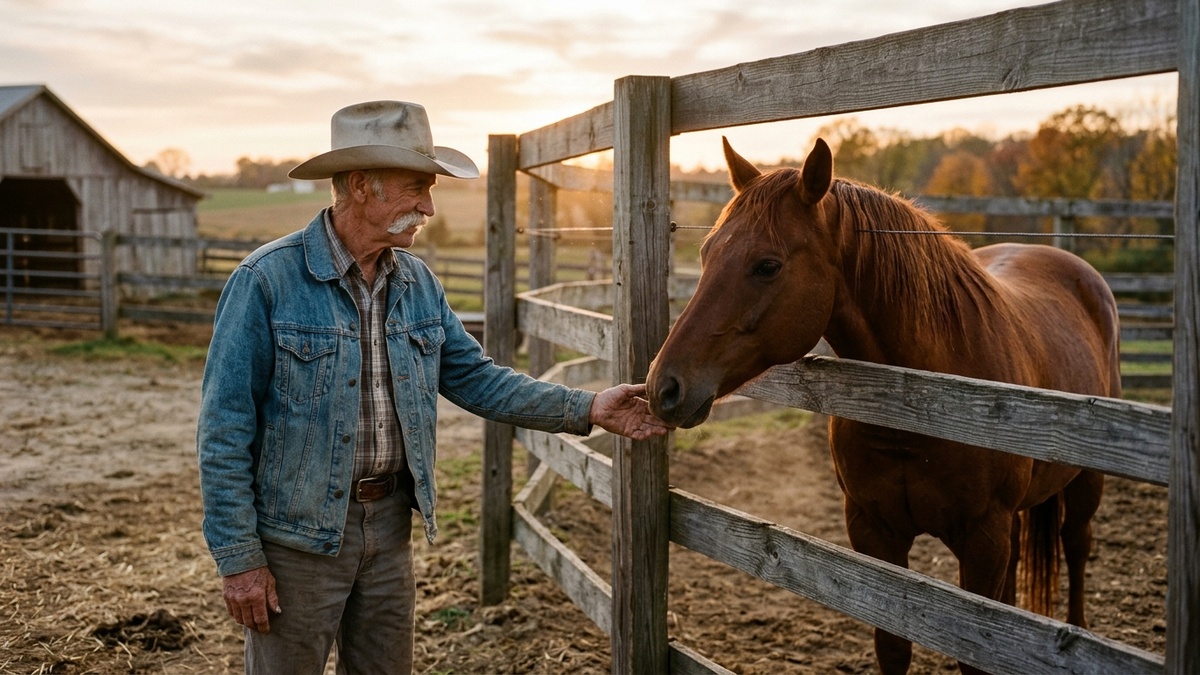
She came to Ray Thibodeaux's funeral with one photograph and a sad story, and by the time the potato salad was gone, half of Bayou Chêne believed she was his daughter.
Marie Thibodeaux was not one of them.
She sat in the front pew of St. Anne's in her black dress with her rosary in her lap and watched the young woman across the aisle. Thirty-five, maybe. Pretty. Red-eyed. She had come in late, during the second reading, and taken a seat by herself near the back. After the Mass, at the hall, she had walked straight up to Marie with the photograph in her hand.
"Mrs. Thibodeaux," she said. "I'm so sorry. My name is Danielle Guidry. I think your husband was my father."
Marie was seventy-two. She had been married to Ray Thibodeaux for fifty years. They had raised cattle on the prairie south of Bayou Chêne, Louisiana, a few hundred acres of flat green pasture between the rice fields and the marsh. They had two sons, both grown, one in Lafayette and one in Houston. They had buried a daughter, Celeste, at three days old in 1979.
Ray had been a quiet man. He worked cattle from a horse, the old way, with a rope and a good dog. He went to Mass on Sundays and fished on Saturdays and was in bed by nine every night of his life.
Marie had never once had a reason to doubt him.
In fifty years, he had missed one Sunday Mass, for a calf coming backward in a rainstorm. He had never stayed out past dark without calling. When the boys were small and cattle prices fell, he had sold his own good saddle to pay the feed bill and ridden an old one for ten years without a word of complaint. That was the man she had married. She knew him the way she knew her own kitchen in the dark.
She took the photograph.
It showed a younger Ray, maybe forty-five, sitting on a sorrel horse in front of a wooden corral. A little girl of about four sat in the saddle in front of him, holding the horn with both hands. Ray had his arm around her. He was smiling his slow, crooked smile.
"That's me," Danielle said softly. "My mother said he used to come see us when I was little. Before he stopped coming."
Marie looked at the photograph a long time. It was Ray's face. It was Ray's hat, the old silver-belly Stetson she had bought him for their twentieth anniversary. It was his smile.
But there was something about it that bothered her, like a hymn sung half a step off key.
"Where did you get this?" she asked.
"My mother had it. She passed in the spring." Danielle wiped her eyes. "I found it in her things, with a letter. That's how I knew his name."
"May I keep this a day?"
Danielle hesitated. Then she nodded. "I have copies."
The story went around the parish hall faster than the gumbo. By the next morning, it had gone around Bayou Chêne twice.
Marie's sons came home that afternoon, Luc from Lafayette and Andre from Houston, and sat with her at the kitchen table. Luc was forty-eight and a lawyer. Andre was forty-four and worked offshore. Both of them had their father's hands.
"Mama, there's a will," Luc said carefully. "Daddy left everything to you. But if she can prove she's his daughter, she can contest it. In Louisiana, that's not simple, but it's not impossible either."
"She called me this morning," Andre said. "She wants to do a DNA test. She says she'll pay for it. She just wants to know."
"A DNA test with who?" Marie said. "Your father's in the ground at St. Anne's."
"With me and Luc. Half siblings would show up."
Marie looked at her sons. She saw the worry in their faces. She saw something else, too, in Andre's, the youngest. A small, terrible doubt.
"Your father was in bed by nine every night for fifty years," she said. "I'd have noticed if he went somewhere else."
That night, after the boys went to bed in their old rooms, Marie sat at the kitchen table under the light with the photograph and Ray's magnifying glass, the one he used to read the fine print on the vaccine bottles.
She looked at Ray's face. She looked at the little girl. She looked at the sorrel horse.
The horse had a white blaze down its face. Ray had owned three sorrel horses in his life. Only one had a blaze, a gelding named Boudin, who had died in 1994. That would fit. Ray would have been forty-five in 1993.
She looked at the corral behind them. Cypress rails. It could have been anywhere in the parish.
She looked at the horse's hip.
Every Thibodeaux animal for three generations had carried the same brand on the left hip. A capital T with a little bar under it, like a man standing on a board. Ray's grandfather had registered it in 1911. Marie had held the irons in the fire for thirty spring brandings.
The brand was there on Boudin's hip, plain in the photograph.
Marie held the magnifying glass closer.
Then she set the glass down on the table and sat very still under the kitchen light, because she understood what had been bothering her, and she did not know yet what it meant.
The Thibodeaux brand was on the wrong hip.