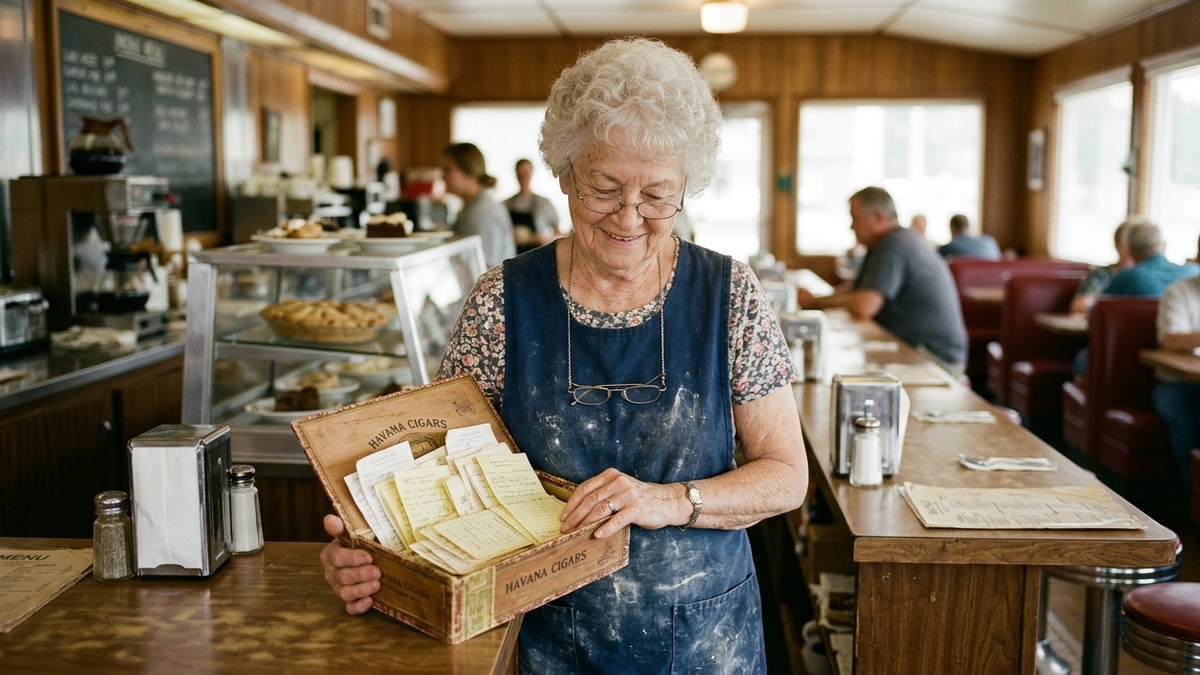
Dot Kessler struck the first match of Christmas Eve at six in the morning, the way she had every morning since 1978, and for the first time in forty-eight years, her old gas range did not light.
She struck another match. She turned the knob again. Nothing. No hiss, no smell of gas, no soft blue flame. The burner sat there under the match like a cold black flower.
Dot tried all six burners and the oven. Then she sat down on the kitchen stool and did not move for a long time.
Tyler found her there at six-thirty, when he came in to start the coffee.
"Grandma?"
"It's dead, hon," Dot said. "The old girl finally died."
Every Christmas Eve since 1979, Dot's Corner Diner had served supper at six for anybody in Pine Hollow who had nowhere else to go. Widowers. Truckers stuck in town. Families who could not afford a ham that year. Last year, there had been sixty-one people at the counter and the booths. Dot cooked it all on the range she had bought used in 1978, the year she opened, for two hundred dollars.
The range had lit with a match every morning for forty-eight years. It had never once failed her.
By seven, the Liars' Table had heard. By eight, half of Pine Hollow had.
Sheriff Earl Whitaker came in at eight-fifteen and sat in the corner booth and listened while Tyler explained it.
The gas company had come out at seven-thirty. The man had checked the line. The gas was fine all the way to the range. The problem was in the range itself. Some valve inside it, between the gas line and the burners, had quit.
"He said they quit making the part decades ago," Tyler said. "He said the company that built that range went out of business in 1991. He said Grandma should buy a new one."
"Can she?"
"Not by six o'clock tonight." Tyler shook his head. "I called four places in Marietta and Zanesville. They can deliver after New Year's. And even if they had one, it'd need a new hookup, and an inspector, and the inspector's off till Monday."
Dot came out of the kitchen wiping her hands on her apron. Her face was gray.
"I'll call the church," she said. "Pastor Greer can put the word out. We'll cancel."
"Don't cancel yet," Earl said.
Dot looked at him.
"Help me understand something, Dot," he said. "How many of those ranges did they make? That model. That year."
"Earl, I don't know. Hundreds. Thousands."
"And how many are still around?"
"I don't know that either."
"Then that's what I'm going to find out," Earl said, and put on his hat.
Earl was sixty-three. He had been county sheriff since 1997. People who did not know him thought he was a slow country cop who drank too much coffee. People who did know him knew that he was slow because he noticed things, and that he drank too much coffee because it helped him notice more.
In 1986, when the glass works closed, Earl had been twenty-three and laid off with six hundred other men. He had walked into Dot's diner that first Monday with forty dollars in his pocket and sat at the counter and ordered coffee, because coffee was all he could afford.
Dot had brought him a grilled cheese and a bowl of soup and said, "On the house, hon."
She did it the next day, and the next. She did it every weekday for eleven months, until he got on with the county. She never once wrote it down. She never once mentioned it again.
Earl had never forgotten it. He did not intend to start forgetting on Christmas Eve.
He drove to the sheriff's office and sat down at his desk with a legal pad, a cup of coffee, and the photograph Tyler had taken of the brass name plate on the front of Dot's range.
He started making calls.
He called the appliance repair shops in four counties. He called a man in Athens who restored old stoves as a hobby. He called the county landfill to ask if anybody had brought in an old gas range in the last six months. He called the secondhand building supply store in Marietta. He called three auctioneers, including Ray Dunbar, who said he had sold a stove like that at an estate sale in 2011 and would think about where it went.
By noon, he had filled four pages of the legal pad. He had found two ranges of the same make. One was in a museum in Columbus. The other was in a barn in Kentucky, and the man who owned it would not sell it.
Earl sat back in his chair and rubbed his eyes.
He thought about how a valve might fail. Not the range, just the valve. One small part, the size of his fist, sitting inside it. He did not need a whole range. He needed the part.
He thought about where old parts go when their kitchens close.
Then he thought about Lou's.
Lou's pawn shop on Front Street in Marietta was a long, narrow room full of guitars, chainsaws, wedding rings, power tools, and forty years of things people had sold when times were hard. Lou himself was seventy-eight. He had a memory like a steel trap and a back room that he had never once, in Earl's experience, let anybody see.
Earl called at twelve-fifteen.
"Lou. Earl Whitaker. I need a favor."
"You always need a favor," Lou said. "What is it this time?"
Earl told him. Lou was quiet a moment.
"1978?"
"1978."
"Hold on."
Earl waited. He heard the phone set down on the counter. He heard footsteps going away, and a door creaking, and a long silence. Then the footsteps came back, slower, and Lou picked up the phone.
"Earl," he said. "I've got a box back here. Came in with a load from a restaurant that closed in Parkersburg in 1993. I never did anything with it." He paused. "It's got the same name on it."
Earl was already on his feet.
"I'll be there in forty minutes."
"Earl," Lou said. "Don't get excited. I haven't opened it. I don't know what's in it. Could be anything."
But Earl had already hung up the phone, and outside his office window, the snow was coming down hard and sideways on Route 9.